Stay up-to-date with the
Press Releases

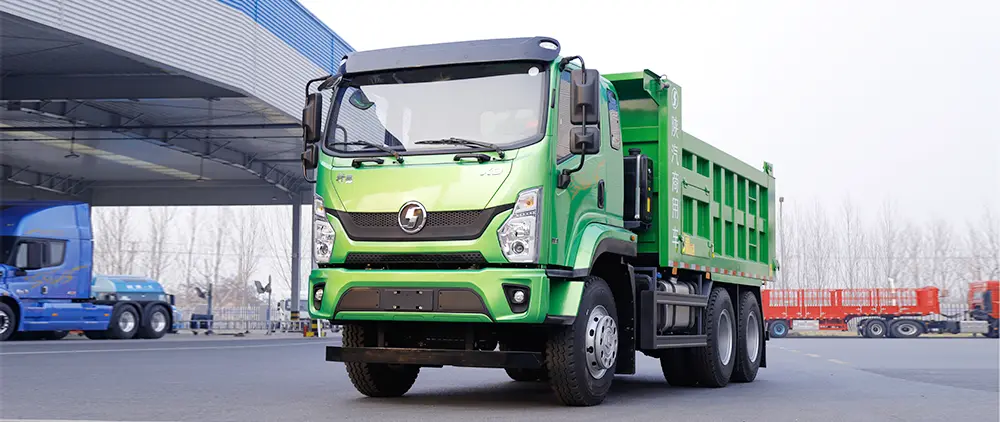
At Mining Indonesia 2026, the busiest corner of the MC Group stand was not a diesel truck. It was an 8×4 dump truck with a 400.61 kWh battery, a 580 kW permanent-magnet motor and no exhaust stack. Four days later the distributor had signed memoranda covering 400 Shacman trucks, handed over 50 cargo units, and closed orders from customers in Sumatra, Kalimantan, Sulawesi and Jambi.
That is the context behind the search term “Shacman Indonesia”. Buyers are no longer asking whether the brand is present in the market. They are asking which electric model fits which route, what the charging plan looks like, and whether the arithmetic still works on an Indonesian haul road. This article answers those three questions with published figures — and marks clearly where a published figure has to be replaced by your own site data.
In short. Shacman’s electric line-up for Indonesia is led by the X5000E 8×4 dump truck — 400.61 kWh CATL LFP pack, 580 kW peak power, 3,000 N·m peak torque — supported by the X5000E and M3000S 6×4 tractors. Electric haulage pays first on fixed, short-cycle routes with controllable charging: mine haulage, port drayage and smelter yards. It rarely pays on long regional runs where the route and the charging point are both uncertain.
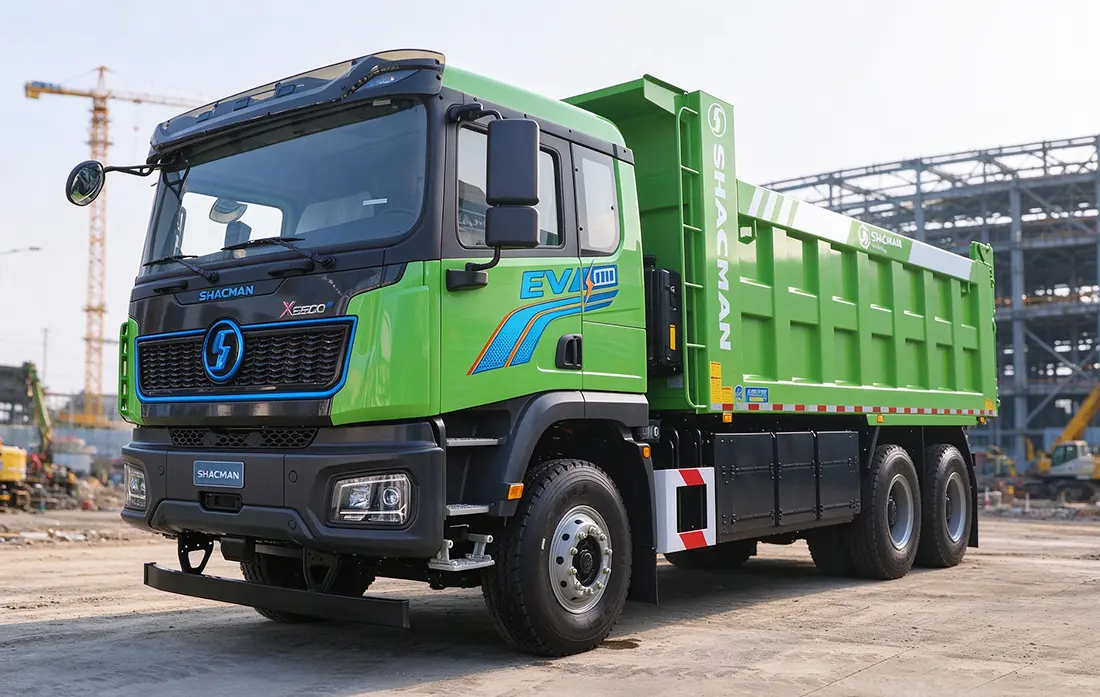
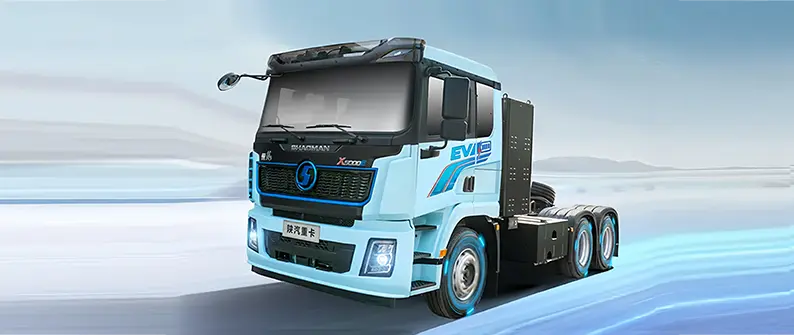
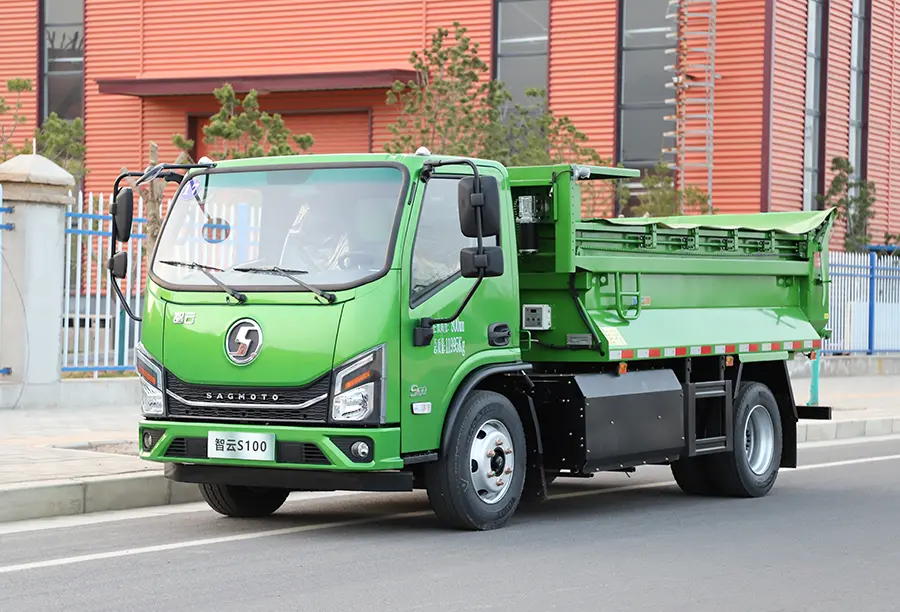
Shacman X5000e Ev 6X4 6.2m Electric Dump Truck

Shacman X5000e Ev 6X4 6.2m Electric Dump Truck
Shacman’s new-energy range is organised around duty cycle rather than around a single platform. For Indonesian buyers, four models matter, and they are not interchangeable.
Table 4. Shacman electric models most relevant to Indonesian operations
|
Model & configuration |
Peak power / torque |
Battery & charging |
Best-fit duty in Indonesia |
|
X5000E, 8×4 dump truck (mining-reinforced) |
580 kW (≈780 hp) / 3,000 N·m |
400.61 kWh CATL LFP, bottom-mounted; dual-gun DC fast charge ≈1 h; battery-swap option |
Short-cycle mine and quarry haulage; steep ramps; two-shift operations with a swap station |
|
X5000E, 6×4 tractor |
410 kW peak, 270 kW rated / 2,400 N·m |
Fixed or swappable pack, quoted per order; depot charging or swap |
Port drayage, regional distribution, fixed container shuttles |
|
M3000S, 6×4 electric tractor |
360 kW / 490 hp equivalent |
282 kWh CATL LFP; DC fast charge to 80% in 1–2 h; 25 t GVW |
On-road container and trailer work, 250–400 km per charge depending on load |
|
H3000E (cement / aggregate) |
— |
350 kWh; adaptive energy recovery; 190 km quoted at full load |
Cement, aggregate and urban construction shuttles with fixed tipping points |
Shacman Indonesia,One detail worth flagging before it reaches a quotation. Indonesian show coverage described the X5000 EV as a “580 HP” truck; Shacman’s own release for the X5000E gives 580 kW, which is about 780 hp. These are not the same number, and on a 90-tonne gross combination the difference is the whole driveline. Put the rating in kW on the order sheet and make the supplier confirm it in writing.

Shacman X5000e Ev Electric Dump Truck

Shacman X5000e Ev Electric Dump Truck
The Shacman Indonesia X5000E uses a permanent-magnet synchronous motor rated at 580 kW peak and 3,000 N·m, driving through an automatic transmission with no clutch to slip. On a ramp, that changes the operator’s job: a loaded start on a 10–12% grade becomes a throttle application rather than a clutch-and-gear sequence. It also removes the wear items that consume diesel driveline maintenance budgets — clutch packs, retarder service, exhaust aftertreatment. The 580 kW figure is not a top-speed claim; it is a grade and restart claim, which is what a mine actually buys.
The pack is LFP chemistry from CATL, mounted low and longitudinally. Two consequences follow. First, the centre of gravity drops compared with a fuel tank and AdBlue package high on the chassis, which matters on side-slope and tip-edge work. Second, the frame rails stay clear for body hydraulics, so the dump body can be specified at roughly 31 m³ in the mining-reinforced configuration without raising the deck. LFP also tolerates daily full cycling and high ambient temperatures better than high-nickel chemistries — a real consideration at a site where the cab sits in 35 °C air and the pack sits above 45 °C ground.
The honest limit is range. At a planning figure of 4 kWh/km on a loaded mine cycle, 400.61 kWh is about 100 km. That is a shift, not a day. Whether the model works for you depends on whether your shift can be planned around one pack — or whether you are prepared to build a swap station.

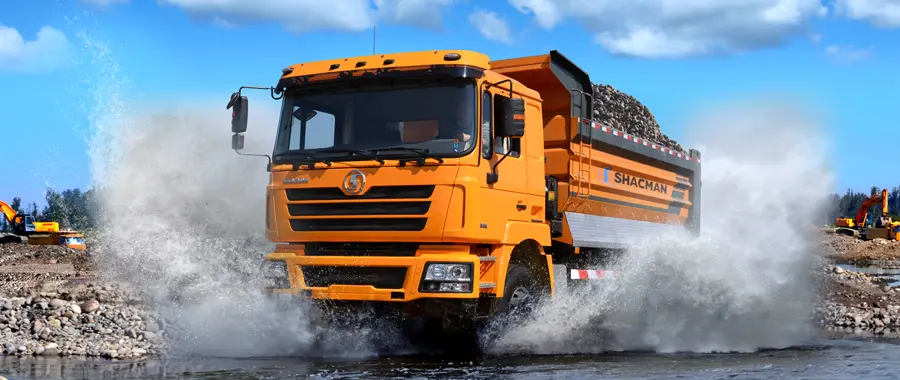
Shacman X5000e 8×4 Ev Electric Dump Truck

Shacman X5000e 8×4 Ev Electric Dump Truck
Shacman quotes dual-gun DC fast charging at roughly one hour, and battery exchange at around five minutes on the swap variants. On a single-shift operation, the charger is enough: the truck charges while the operator sleeps. On a two-shift mine, the swap matters more than the charger, because a charger puts the truck in a queue while a swap station takes it out of one. The distinction is operational, not technical, and it is the single most common reason an electric haulage pilot succeeds or stalls.
The loaded climb is the expensive half of a mine cycle; the empty descent is the free half. Regenerative braking recovers a meaningful share of the energy spent climbing, which is why electric consumption on a deep pit is often better than a flat-road estimate suggests. The corollary is equally true: on a flat, free-flowing route with little braking, there is less to recover, and the case rests almost entirely on the diesel-to-electricity price gap.
Three things stay outside the motor’s reach. Battery mass reduces payload unless the GVW rating and axle loads are re-engineered for the configuration — check the permitted axle load, not the brochure payload. Heat and dust demand a cooling and filtration discipline that many Indonesian sites do not yet have. And a quiet driveline removes an operator’s audible warning that the machine is working; brake-temperature and pack-temperature monitoring have to be specified deliberately, not inherited from a diesel habit.
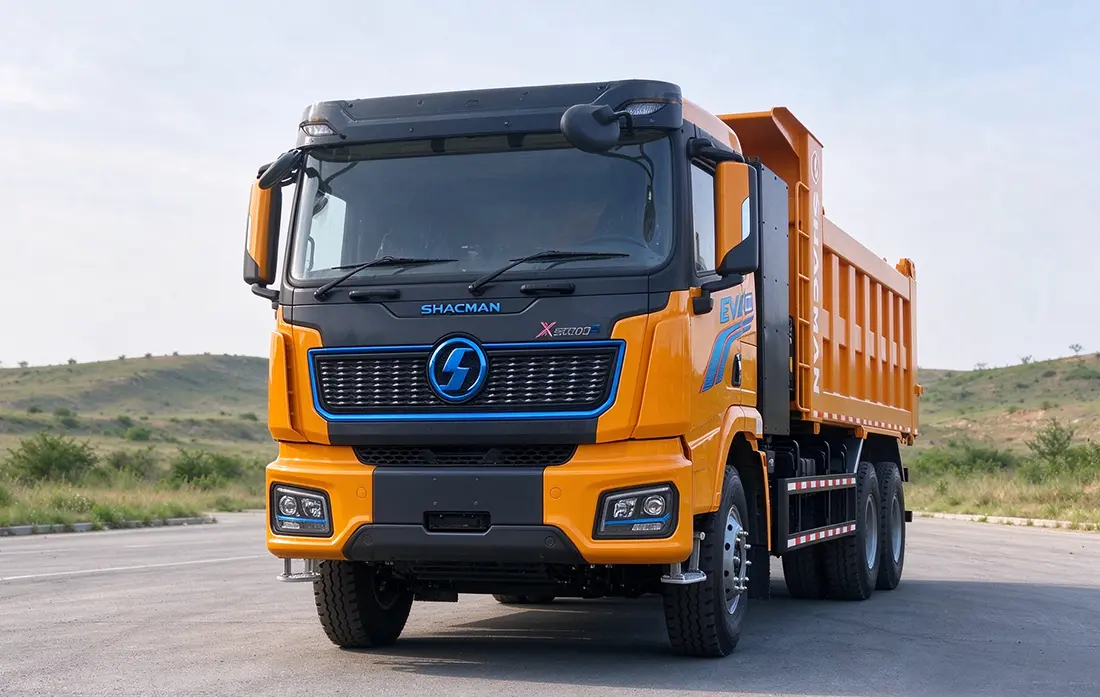
Shacman X5000e Ev 6×4 Tipper Truck
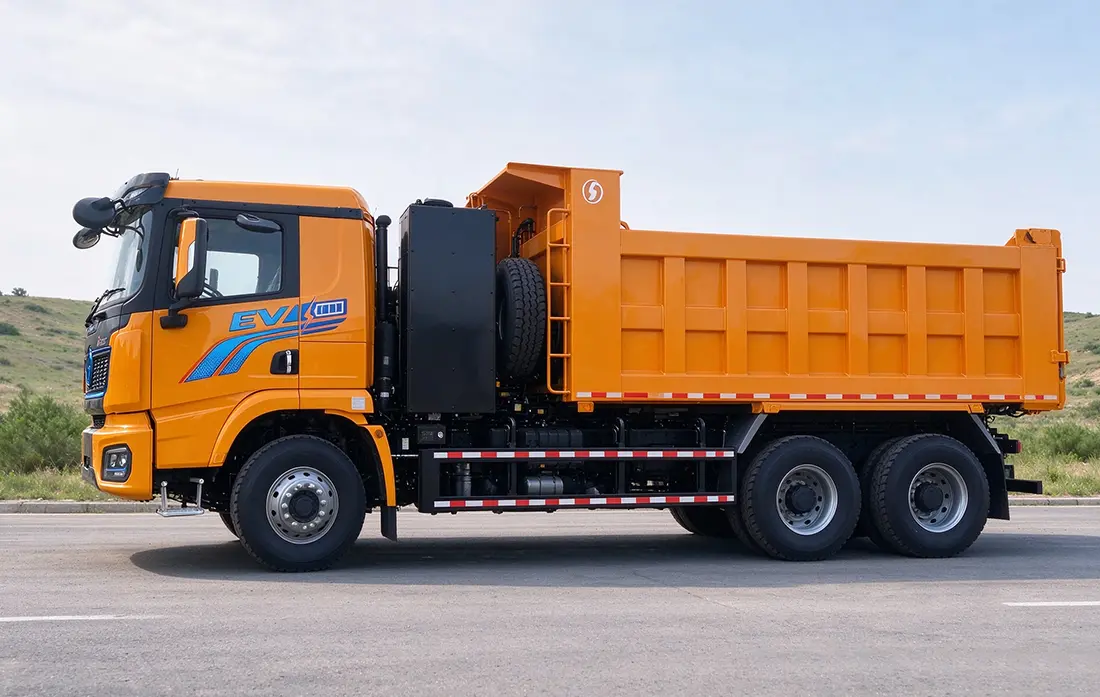
Shacman X5000e Ev 6×4 Tipper Truck
Electric haulage in Indonesia stopped being theoretical in 2026. At Kideco in East Kalimantan, 18 battery-electric mine trucks and three battery-swap stations entered operation in September 2026, with reported energy-cost savings of up to 50% against the diesel fleet they replaced. That number is a site result, not a product claim, and it belongs to a specific cycle length, gradient and electricity tariff.
Take a planning figure of 60 L/100 km for a loaded 8×4 diesel dump on a mine haul, and industrial diesel at IDR 13,000 per litre. That is IDR 780,000 per 100 km. A 580 kW electric unit on the same cycle at 4 kWh/km and IDR 1,400/kWh uses 400 kWh, or IDR 560,000 — roughly 28% lower on energy alone.
No engine oil, no fuel filters, no exhaust aftertreatment, and fewer brake services because the motor retards. Against that, three new cost lines appear: battery thermal management, high-voltage safety training for technicians, and charger or swap-station maintenance. On a well-run site these net out favourably. On a site with no HV-trained technician, they do not, and the training line should be in the budget before the first truck arrives.

Shacman X5000e 8×4 Ev Dump Truck

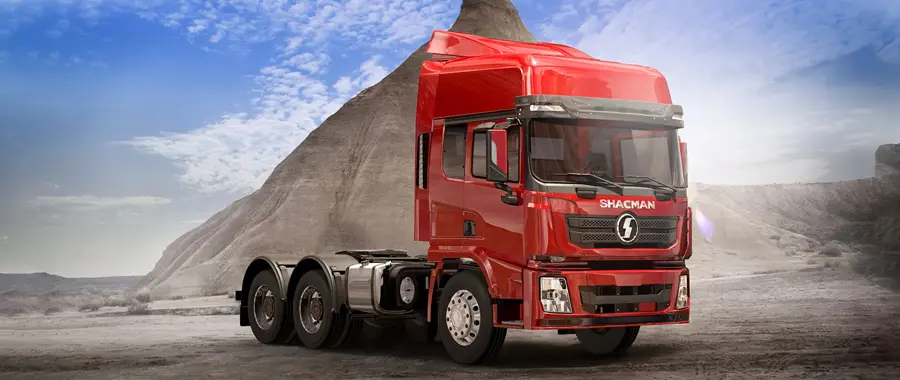
Shacman X5000E 6×4 Ev Electric Tractor Truck
Model the day in cycles plus a charging window. If the pack covers the shift, you are comparing diesel fuel with electricity and very little else changes. If it does not, you are not buying a truck any more — you are buying a swap station, spare packs and a new operating procedure, each with its own payback. Fleet managers who skip this step tend to discover it in month three, when the second shift starts waiting.
Ask for the warranty in writing with four numbers: capacity retention threshold, cycle count, calendar years, and what happens if the pack falls below the threshold while the truck is still in service. Then ask who owns the pack if it is leased or swapped, and how that ownership transfers if the truck is resold. These four numbers determine residual value more than any specification on the data sheet.

Shacman X5000E 6×4 Ev Electric Tractor Truck

Shacman X5000E 6×4 Ev Electric Tractor Truck
The order of work matters. Energy per shift comes first: kWh/km multiplied by kilometres per shift. A 100 km shift at 4 kWh/km is 400 kWh, which is one X5000E pack — the boundary case. From there the charger follows arithmetically: 400 kWh inside a one-hour window needs roughly 400 kW delivered; inside two hours, 200 kW. Two trucks sharing one charger doubles the window, and a shift plan that ignores this will quietly lose a truck-hour per day.
Then the grid. A fleet charging simultaneously pulls megawatts, not kilowatts, and a PLN connection upgrade is a months-long item with its own engineering review. Sites that ordered chargers after the trucks arrived are the reason “electric trucks are unreliable” is still a sentence in this market. Finally, site conditions: charger cabinets need filtered, shaded siting, because a 400 kW cabinet in 35 °C ambient derates, and a derated charger turns a one-hour window into ninety minutes on the hottest part of the day.
If you choose swapping instead, plan for at least one spare pack per truck, handling equipment rated for the pack mass, and a written position on pack warranty transfer. A swap station is a capital project; treat its payback separately from the truck’s.
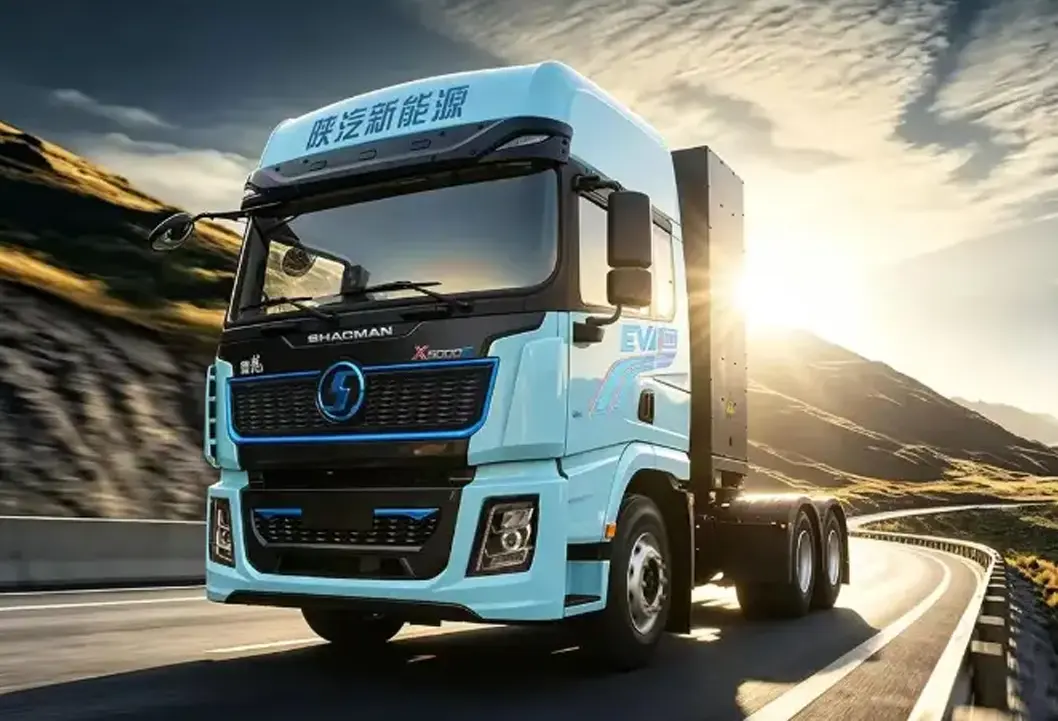
Shacman X5000E 6×4 Ev Electric Tractor Truck
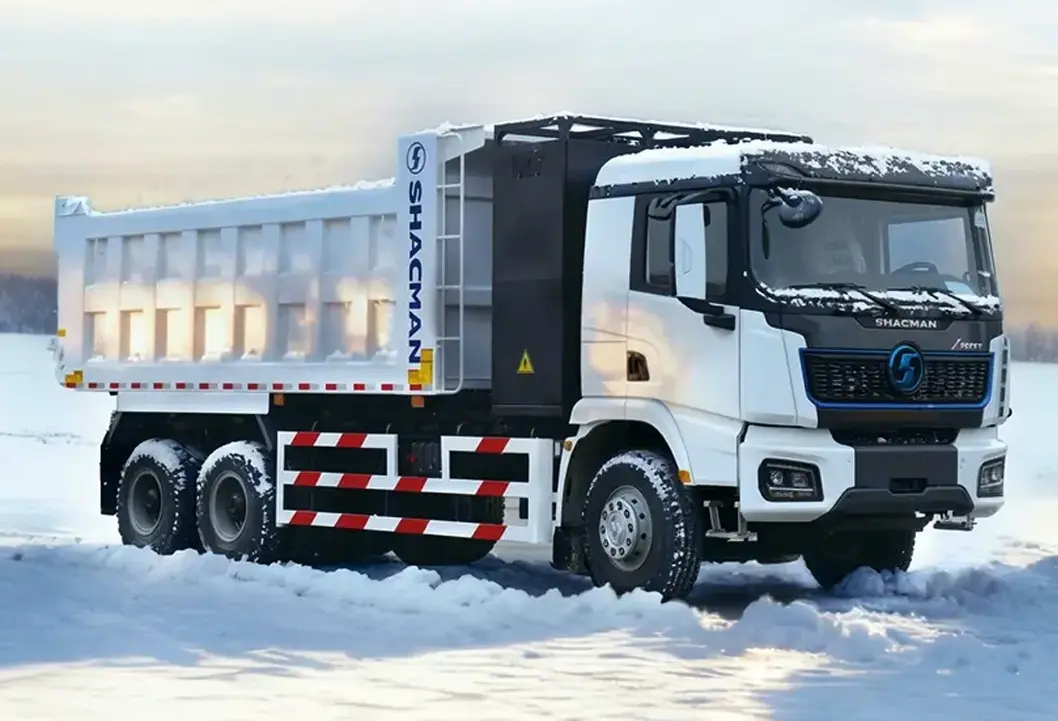
Shacman X5000e Ev 6X4 Electric Dump Truck
None of these questions is about the truck. All of them decide whether the truck runs in month twelve.

Shacman X5000E Electric Tractor Truck

Shacman X5000E Electric Tractor Truck
The range covers the X5000E 8×4 electric dump truck, the X5000E 6×4 electric tractor, the M3000S 6×4 electric tractor and the H3000E. Availability depends on the importer’s homologated list and on configuration — battery capacity, body volume and charging package are all fixed per order.
The X5000E carries a 400.61 kWh pack. At a planning figure of 4 kWh/km on a loaded mine cycle, that is roughly 100 km per charge; on lighter cycles or with more regeneration on descents, it is more. Published figures range widely because gradient, payload and ambient temperature dominate, so treat any single number as a starting point and validate it against your cycle data.
Shacman quotes dual-gun DC fast charging at about one hour for the X5000E, and battery exchange at roughly five minutes on swap variants. Swap capability requires a station, spare packs and handling equipment, and it is usually the better choice for two-shift operations.
The purchase price is higher, mainly because of the pack. The payback comes from energy and maintenance, and it depends on your diesel price, electricity tariff, cycle length and utilisation. At the planning assumptions above, energy cost is about 28% lower per 100 km; on a deep-pit cycle with heavy idling, the gap is materially wider. Model it with your own numbers before comparing invoices.
The X5000E is specified with a reinforced frame, wear-resistant dump body and LFP chemistry that tolerates high ambient temperatures and daily full cycling. Heat and dust still require deliberate specification: pack cooling capacity, filtration and charger siting. A supervised trial on your own cycle is the only reliable answer, and any supplier who discourages one is telling you something.
Shacman’s official Indonesia service listing includes stations in Jakarta and Sumatra, and the distributor network handles periodic service and parts. For electric models, ask specifically about HV-certified technicians, pack diagnostics capability and the lead time on electric-specific parts, because those are the items that differ from the diesel service model.

Copyright @2023 Shacman. All Rights Reserved. Privacy Policy.